
SUPER Human Blend
Original price was: $200.00.$120.00Current price is: $120.00.
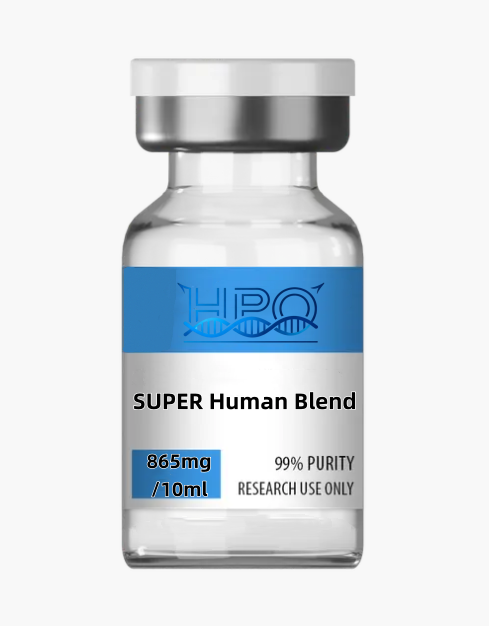
SUPER Human Blend is a nine-component amino-acid and metabolite formula for laboratory studies of nitrogen, redox and mitochondrial pathways. Research use only.
DISCLAIMER:
SUPER Human Blend Research Guide: Nine-Component Amino-Acid Formula
SUPER Human Blend is a multi-component research formula containing L-arginine, L-ornithine, L-citrulline, L-lysine, L-glutamine, L-proline, taurine, L-carnitine and N-acetyl-L-cysteine (NAC). Based on the amounts shown on this product page, the labeled total is 865 mg. The blend is designed for laboratory investigation of interconnected nitrogen, amino-acid, redox and mitochondrial-metabolism pathways.
Despite the product name sometimes appearing beside peptide catalogs, this formulation is not a single peptide with one sequence or molecular weight. It is a mixture of free amino acids and related small molecules. Evidence about an individual ingredient cannot automatically be attributed to the complete blend, and the finished formulation requires its own controls, compositional verification and stability assessment. This material is supplied strictly for laboratory research, not for human or veterinary use.
Labeled composition
| Component | Labeled amount | Primary research context |
|---|---|---|
| L-Arginine | 110 mg | Nitric-oxide synthase substrate; urea-cycle and nitrogen metabolism |
| L-Ornithine | 110 mg | Urea-cycle intermediate and polyamine-pathway research |
| L-Citrulline | 120 mg | Arginine recycling and nitric-oxide precursor studies |
| L-Lysine | 70 mg | Protein synthesis, post-translational modification and carnitine biosynthesis |
| L-Glutamine | 40 mg | Nitrogen transfer, nucleotide synthesis and cell-culture metabolism |
| L-Proline | 60 mg | Collagen-related metabolism and redox-linked proline cycling |
| Taurine | 60 mg | Osmoregulation, membrane function, calcium handling and redox models |
| L-Carnitine | 220 mg | Carnitine shuttle, acyl-group transport and fatty-acid oxidation |
| N-Acetyl-L-cysteine (NAC) | 75 mg | Cysteine delivery, glutathione metabolism and thiol-redox studies |
| Total labeled content | 865 mg | Multi-pathway research formula |
The table records label amounts, not independently verified assay values. Researchers should consult the lot documentation to determine whether the stated quantities represent target fill, measured content or another basis. The physical and chemical behavior of the mixture may differ from that of each isolated component.
Component pathways and research rationale
Arginine, citrulline and nitric-oxide metabolism
L-arginine is a substrate for nitric-oxide synthases and also participates in the urea cycle, protein synthesis, creatine metabolism and polyamine pathways. L-citrulline can be recycled to arginine through argininosuccinate synthase and argininosuccinate lyase. Review literature notes that citrulline and arginine differ in absorption, first-pass metabolism and cellular channeling, so equal nominal amounts should not be assumed to produce equal intracellular exposure.
Useful experimental readouts include arginine and citrulline concentrations, nitrate/nitrite, enzyme expression, isotopic flux and cell viability. Nitric oxide is context-dependent: concentration, timing, NOS isoform, oxygen tension and redox environment can alter its biological consequences. Measurements should therefore distinguish pathway activity from nonspecific oxidative or cytotoxic effects.
Ornithine and nitrogen handling
L-ornithine is a nonprotein amino acid central to the urea cycle. It can also enter polyamine synthesis through ornithine decarboxylase. When arginine, citrulline and ornithine are studied together, competition for transport and changes in nitrogen flux may be as important as their individual concentrations. Stable-isotope tracing can help resolve whether a response reflects urea-cycle turnover, arginine regeneration or downstream polyamine metabolism.
Lysine, proline and matrix-oriented models
L-lysine and L-proline are proteinogenic amino acids frequently examined in protein and extracellular-matrix research. Collagen is rich in proline-related residues, while lysine residues may undergo enzymatic modifications and cross-linking processes. Supplying free amino acids does not by itself prove increased collagen synthesis. Matrix studies should directly measure newly synthesized protein, hydroxyproline-related endpoints, matrix organization and degradation rather than infer outcomes from ingredient presence.
Glutamine and cell-culture metabolism
L-glutamine is widely used as a carbon and nitrogen source in cultured cells. It contributes to nucleotide synthesis, anaplerotic metabolism and amino-group transfer, but its stability in solution and consumption rate vary by medium and cell type. Because glutamine is already present in many culture media, investigators must calculate background concentration before adding the blend. Otherwise, the experimental increment may be misreported or biologically negligible.
Taurine, osmotic balance and cellular stress
Taurine is a beta-aminosulfonic acid rather than a proteinogenic amino acid. It is studied in relation to cell-volume regulation, membrane stabilization, calcium handling and redox homeostasis. Reviews also emphasize important differences between animal and human skeletal-muscle findings. In vitro experiments can quantify intracellular taurine, transporter expression, osmotic responses, calcium flux and oxidative-stress markers while avoiding broad performance claims.
L-carnitine and mitochondrial substrate transport
L-carnitine participates in the transport of long-chain acyl groups across the inner mitochondrial membrane through the carnitine shuttle. Relevant endpoints include free carnitine, acylcarnitine profiles, oxygen consumption, fatty-acid oxidation and mitochondrial membrane potential. Adding carnitine does not guarantee increased oxidation: transporter abundance, CPT1 regulation, substrate supply and cellular energy state can all be limiting.
NAC and thiol-redox chemistry
N-acetyl-L-cysteine is an acetylated cysteine derivative used in research on glutathione availability and disulfide reduction. Its effects depend on cysteine limitation, cellular uptake, pH, oxidant species and exposure time. NAC may also interact directly with assay reagents or alter extracellular redox conditions, so cell-free interference controls are valuable when using fluorescence, colorimetric or thiol-sensitive assays.
How to study the complete blend
1. Mixture-versus-component comparison
A factorial or staged design should compare the full formula with vehicle, each component alone and selected sub-mixtures. This is the clearest way to determine whether an observation is driven by one ingredient, simple additivity or an interaction. At minimum, match the concentration of each ingredient in the single-component arm to its concentration within the full blend.
2. Concentration-response design
The labeled milligram ratio defines relative composition, not an appropriate concentration for every model. Establish a dilution series guided by solubility, osmolarity, pH and preliminary viability testing. Report both total mixture concentration and the resulting concentration of each component. Avoid describing a response as dose-dependent unless multiple independent concentrations support the conclusion.
3. Metabolic-flux studies
Targeted LC-MS or stable-isotope tracing can examine arginine-citrulline cycling, nitrogen transfer, glutamine use, proline metabolism and acylcarnitine formation. Time-resolved sampling is preferable to a single endpoint because metabolic pools can change quickly and may return toward baseline even when pathway flux remains altered.
4. Mitochondrial and redox models
Oxygen-consumption rate, extracellular acidification, ATP-linked respiration, glutathione redox status and reactive-species probes may be combined with viability and cell-count normalization. No single fluorescent probe is a universal measure of oxidative stress. Orthogonal chemical or enzymatic assays reduce the risk of interpreting probe interference as a biological effect.
5. Cell-stress and recovery experiments
Researchers may test the formula under defined nutrient limitation, oxidative challenge or recovery conditions. The stressor, duration and washout procedure must be specified. A result observed only under one severe challenge should not be generalized to normal physiology, and rescue of a metabolic readout should be distinguished from improved survival or proliferation.
6. Analytical compatibility and stability
Nine components create separation and quantification challenges. A validated method should resolve each analyte and relevant degradation products, account for matrix effects and demonstrate acceptable recovery. Solution stability can be affected by pH, temperature, oxygen, light and interactions among ingredients; it should be measured under the exact working conditions.
Essential controls
- Vehicle control: match solvent, salts, pH and handling.
- Osmolarity control: determine whether total solute load explains the response.
- Full-mixture control: retain the exact labeled component ratio across dilutions.
- Single-component arms: identify dominant contributors.
- Leave-one-out mixtures: test whether a particular component is necessary.
- Positive control: verify that the selected pathway assay is responsive.
- Cell-free interference control: detect chemical effects on probes and reagents.
- Viability and cell-number normalization: separate metabolic changes from altered cell abundance.
Use independent biological replicates, randomize sample order where practical and prespecify primary endpoints. A multi-ingredient formula can generate many comparisons, so statistical correction and transparent designation of exploratory analyses are especially important.
Lot-specific quality review
A mixture cannot be adequately characterized by one total mass or one nonspecific purity value. Researchers should review documentation for ingredient identity, relative content, homogeneity and potential degradants. Depending on the study, useful tests include:
- identity of each component by suitable chromatographic and mass-spectrometric methods;
- quantitative assay for each labeled ingredient;
- blend uniformity and total fill mass;
- water content, residual solvents and relevant inorganic ions;
- solution pH, appearance and particulate assessment;
- stability-indicating testing at planned storage and working conditions;
- microbial, endotoxin or sterility results only when specifically tested.
Do not assume that “high purity” for one raw material proves the finished mixture’s identity or uniformity. For quantitative experiments, calculations should use measured lot content when available rather than nominal total powder mass alone.
Handling and storage principles
Follow the product label and lot documentation. Keep the container sealed, dry and protected from unnecessary light and temperature cycling. Allow a cold sealed container to equilibrate before opening to reduce condensation. Select a solvent compatible with every ingredient and with the planned assay; confirm clarity, pH and recovery after preparation.
Use calibrated laboratory equipment and a contamination-control procedure appropriate to the experiment. Divide prepared material into validated aliquots when useful and avoid repeated freeze-thaw cycles. Establish solution stability analytically rather than relying on a universal timeframe. This page intentionally provides no administration, injection or human dosing instructions.
Frequently asked questions
What is SUPER Human Blend?
It is a nine-component research mixture containing six proteinogenic amino acids, taurine, L-carnitine and NAC. The labeled amounts total 865 mg. It is not a single peptide and has no single amino-acid sequence or molecular weight.
Has the complete blend been clinically validated?
No clinical efficacy should be inferred from research on the individual ingredients. The finished combination requires direct compositional, preclinical and clinical evaluation before any claim about the blend as a whole could be supported.
Why include both arginine and citrulline?
They occupy related but distinct positions in arginine recycling and nitric-oxide metabolism. Their transport and first-pass handling differ, which makes the combination useful for comparative pathway and flux studies.
What concentration should a laboratory use?
There is no universal concentration. Build a model-specific dilution series based on solubility, osmolarity, pH and viability. Report the total blend concentration and the corresponding concentration of all nine ingredients.
How can ingredient interactions be investigated?
Compare the complete formula with single components, rational sub-mixtures and leave-one-out versions. Interaction models require adequate replication and should distinguish synergy, additivity and antagonism using prespecified criteria.
How should the formula be stored?
Use the conditions on the product label and lot documents. Protect the dry material from moisture and unnecessary temperature cycling, and validate solution stability in the exact solvent, container and temperature used for the study.
Is this product intended for human or veterinary use?
No. It is a laboratory research material only. It is not supplied for consumption, injection, diagnosis, treatment, disease prevention, veterinary use, cosmetic application or household use.
Related research materials
Comparative metabolic and redox programs may also review Glutathione, NAD+, AICAR, MOTS-c, SS-31, Humanin, GLOW and KLOW. Each has a different composition and evidence base and should not be treated as an interchangeable substitute.
Selected references
- Endogenous flux of nitric oxide: citrulline compared with arginine.
- Carnitine transport and fatty-acid oxidation.
- N-acetylcysteine as an antioxidant and disulfide-breaking agent.
- Taurine, cellular redox homeostasis and skeletal-muscle function.
- Taurine and skeletal-muscle function: animal and human evidence differences.
Research use only. Not for human or veterinary use, diagnosis, treatment, prevention, food, cosmetic or household applications. Researchers are responsible for institutional review, risk assessment and compliance with applicable laws and policies.
Related Research Guides
Expand your peptide research knowledge with our comprehensive guides:
- Peptides for Anti-Aging: Complete Research Guide 2026
- Peptides for Cognitive Enhancement: Nootropic Research Guide 2026
- Peptides for Metabolic Health: Weight Loss Research Guide 2026
- Peptides for Athletic Performance: Muscle Growth Research Guide 2026
- Peptides for Skin Health: Dermatological Research Guide 2026
- Peptides for Sleep Optimization: Circadian Rhythm Research Guide 2026
- Peptides for Sexual Health and Fertility: Complete Research Guide 2026
- Peptides for Immune Support and Inflammation: Complete Research Guide 2026
- Peptides for Cardiovascular Health: Vascular Research Guide 2026
- Peptides for Gut Health and Digestive Function: Complete Research Guide 2026
- Peptides for Pain Management and Analgesia: Complete Research Guide 2026
- Peptides for Liver Health and Detoxification: Complete Research Guide 2026
- Peptides for Joint Health and Cartilage Repair: Complete Research Guide 2026
- Peptides for Eye Health and Vision Protection: Complete Research Guide 2026
- Peptides for Emotional Health and Anxiety Management: Complete Research Guide 2026
UK Research Peptide Guides
| Specification | 10mg*10vials |
|---|
Only logged in customers who have purchased this product may leave a review.
Related products
Reviews
There are no reviews yet.