
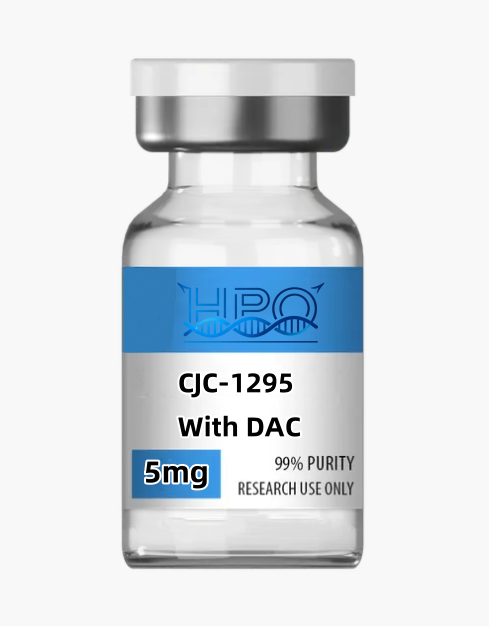
CJC-1295 With DAC: Identity, GHRH Signaling and Laboratory Quality Guide
FOR RESEARCH USE ONLY. CJC-1295 With DAC is supplied solely as an analytical and laboratory research reagent. It is not for human or veterinary use, food, cosmetic, diagnostic, therapeutic, bodybuilding, or performance-enhancement purposes.
Research overview
CJC-1295 With DAC is an engineered growth hormone-releasing hormone (GHRH/GRF) analogue carrying a reactive maleimide-based Drug Affinity Complex (DAC). The DAC group was designed to react with the free thiol of cysteine-34 in circulating albumin, producing an in vivo peptide-albumin conjugate and extending systemic exposure.[1] This albumin-binding construct is chemically different from the shorter, non-DAC material often marketed as “CJC-1295 without DAC” or modified GRF(1-29). Researchers must not treat those names as interchangeable.
The strongest directly relevant published evidence consists of early receptor, animal, analytical and small healthy-volunteer studies. In two randomized, placebo-controlled, ascending-dose studies, CJC-1295 produced sustained changes in circulating GH and IGF-I, with an estimated half-life of 5.8–8.1 days under the studied conditions.[2] A separate study found that pulsatile GH secretion persisted during continuous stimulation.[3] These pharmacology findings do not establish treatment efficacy, safe self-use, improved body composition, anti-aging, recovery, sleep, or any other health outcome.
FDA has stated that available clinical data are limited and has identified characterization, peptide-related impurity, immunogenicity and safety concerns for compounded products containing CJC-1295, including reports of increased heart rate and systemic vasodilatory reaction.[4] This page therefore emphasizes exact identity, controlled experimental design, analytical verification and evidence limits. It intentionally contains no dosing, injection, reconstitution, cycle, stacking or personal-use directions.
Molecular identity and nomenclature
| Catalog name | CJC-1295 With DAC |
|---|---|
| Research class | Long-acting, albumin-binding GHRH analogue |
| Reference sequence | Tyr-D-Ala-Asp-Ala-Ile-Phe-Thr-Gln-Ser-Tyr-Arg-Lys-Val-Leu-Ala-Gln-Leu-Ser-Ala-Arg-Lys-Leu-Leu-Gln-Asp-Ile-Leu-Ser-Arg-Lys-NH2, with the terminal lysine modified by a maleimide-containing linker |
| PubChem reference | CID 91971820; molecular formula C165H269N47O46; computed average molecular mass 3647.2 g/mol[5] |
| FDA identifier | UNII 62RC32V9N7; FDA GSRS records the 30-residue sequence and structural modification[6] |
| CAS reference | 446262-90-4 for the PubChem free structure |
| Physical form | Lot-specific; commonly supplied as a lyophilized research material |
| Purity and content | Lot-specific only. HPLC area percentage is not equivalent to peptide content, identity, salt-corrected mass or biological activity. |
| Storage | Follow the current lot label, certificate of analysis (CoA) and safety data sheet. No universal shelf life is implied. |
The formula and mass above describe the standardized PubChem structure, not necessarily the as-supplied vial mass. Counterions, water, residual solvent and other non-peptide material can contribute to gross mass. The maleimide group can also hydrolyze or react with thiols, changing the analyte that an assay must detect. A CoA should state whether reported quantity refers to the free peptide, a particular salt, an as-is material or peptide-equivalent content.
“With DAC” must be supported analytically. A 29-residue non-DAC analogue lacks the albumin-reactive structural element and has different mass, reaction behavior and pharmacokinetics. A product name, nominal vial amount or single retention time cannot resolve this distinction. The reference identity should include intact mass, the expected sequence, terminal modification and evidence for the maleimide-bearing lysine.
Mechanistic framework
1. GHRH receptor activation
GHRH receptor is a class B G-protein-coupled receptor expressed prominently by pituitary somatotrophs. Agonist binding can activate Gs, adenylyl cyclase, cyclic AMP and protein kinase A, with downstream effects on calcium handling, transcription and regulated GH secretion. A receptor assay should distinguish direct receptor activation from secondary endocrine changes. Appropriate controls include vehicle, native GHRH or a qualified comparator, receptor-negative cells, concentration-response testing and a pathway-level antagonist or genetic perturbation.
2. Covalent albumin association
The defining DAC concept is covalent capture by accessible thiols, particularly albumin Cys34.[1] Albumin association can reduce renal clearance and protect a peptide from some degradation pathways, but it also creates a heterogeneous, high-molecular-weight analytical target. Free peptide, hydrolyzed maleimide, albumin conjugate and off-target thiol adducts should be treated as different species. Albumin concentration, redox state, fatty-acid loading, pH and competing thiols can affect conjugation kinetics in vitro.
3. Sustained GH and IGF-I pharmacodynamics
The 2006 healthy-adult study reported dose-dependent increases in mean plasma GH for six days or more and mean IGF-I for nine to eleven days after a single studied administration, with accumulation after repeated exposure.[2] Those results demonstrate pharmacodynamic persistence in a specific early clinical protocol; they do not supply a general laboratory half-life, a consumer schedule or evidence of therapeutic benefit. Species, matrix, albumin status and assay design can all change apparent exposure.
4. Preserved pulsatility under prolonged stimulation
In healthy men studied before and one week after exposure, frequent overnight sampling showed that GH pulsatility was retained during continuous CJC-1295 stimulation.[3] This is a narrower conclusion than claims that secretion becomes “natural,” “optimized” or risk-free. Pulse analysis requires dense time-series sampling, prespecified deconvolution methods and attention to sleep, food intake, stress, exercise and circadian timing.
5. Downstream GH-receptor signaling
Secreted GH can engage the GH receptor and JAK2–STAT pathways in responsive systems, while hepatic and peripheral responses can alter IGF-I and binding proteins. These downstream biomarkers are not specific to CJC-1295 and may be influenced by many physiological variables. An experiment seeking causal attribution should measure the test article, receptor-proximal signals and downstream mediators, rather than inferring direct peptide action from IGF-I alone.
6. Feedback and time dependence
The GH/IGF axis includes negative feedback through IGF-I, somatostatin and hypothalamic-pituitary regulation. Continuous receptor availability does not imply a constant downstream response. Sampling only one time point can miss pulses, adaptation or delayed responses. A defensible study uses a time course and separates pharmacokinetics, receptor activity and biomarker dynamics.
Evidence map and research applications
Receptor and albumin-conjugation research
The original preclinical work investigated hGRF(1-29)-albumin bioconjugates in rat pituitary systems and identified CJC-1295 as a long-lasting analogue.[1] This supports research questions about covalent half-life extension, receptor activation after conjugation, conjugation efficiency and the influence of albumin chemistry. It does not validate all commercial materials sold under the same name.
Endocrine time-series research
The published healthy-volunteer studies provide a basis for studying the temporal relationship among a long-acting GHRH analogue, GH pulse parameters and IGF-I.[2][3] Their small, early-phase populations and pharmacology-focused endpoints limit generalization. Claims about muscle, fat, sleep, cognition, longevity, injury recovery or disease treatment require direct controlled outcome data and cannot be inferred from hormone changes.
GHRH-deficiency models
In GHRH-knockout mice, CJC-1295 was evaluated for its ability to restore growth-related endocrine signaling.[7] Such a genetic model can help separate GHRH-pathway dependence from nonspecific effects, but developmental mouse results do not establish an indication in healthy adults, older people or patients with endocrine disease.
Bioanalytical and anti-doping research
Immunoaffinity enrichment coupled with high-resolution mass spectrometry has been used to identify CJC-1295 and related peptide hormones in complex biological matrices.[8] These studies illustrate the need for selective enrichment, high-resolution detection, fragmentation evidence and matrix-specific validation. CJC-1295 is also listed by WADA among prohibited GHRH analogues, making anti-doping compliance relevant to accredited sports-science work.[9]
Safety-signal and impurity research
FDA’s assessment highlights potential immunogenicity, peptide-related impurities, characterization complexity and serious adverse-event reports, while noting limited clinical data.[4] FDA’s 2024 advisory materials also described nonclinical local-irritation and genotoxicity signals and stated that carcinogenicity-related uncertainties remain.[10] These records support cautious hazard assessment and strong identity controls; they do not authorize clinical use.
Experimental design and assay controls
- Define the test article. Record lot, nominal amount, chemical form, sequence, terminal modifications, counterion basis, water, storage history and opening date.
- Confirm identity before activity. Use intact-mass analysis and sequence-supporting MS/MS, with specific evidence for the DAC modification. A biological response cannot substitute for chemical identification.
- Separate free and conjugated species. If albumin is present, quantify or characterize free peptide, albumin-bound material and hydrolysis products across the experimental interval.
- Use receptor-specific controls. Include GHRH-receptor-negative or perturbed systems, a qualified agonist comparator and pathway controls.
- Measure a time course. Long-lived exposure and pulsatile biology require repeated sampling. Prespecify primary time points and pulse-analysis methods.
- Control the matrix. Assess adsorption, thiol content, albumin concentration, pH, protease activity and ion suppression in the exact experimental system.
- Separate mechanism from outcome. Distinguish receptor activation, GH release, IGF-I changes and phenotypic endpoints. Do not label correlation as direct action.
- Protect reproducibility. Randomize positions, blind analysis where practical, report exclusions, track lots and use independent biological replicates.
Analytical quality control
- Intact identity: LC–HRMS with justified mass tolerance, isotope pattern, charge-state assignments and qualified reference comparison.
- Sequence and modification: MS/MS coverage sufficient to distinguish the intended analogue from native GHRH and non-DAC variants; verify the maleimide-bearing lysine and C-terminal amidation.
- Purity profile: gradient reversed-phase chromatography with disclosed wavelength, column, mobile phases and integration rules. Report area purity only as an area-based result.
- Content: establish actual peptide content using a calibrated, fit-for-purpose method. Do not equate lyophilized cake mass with active peptide mass.
- Related substances: investigate deletion sequences, truncations, oxidation, deamidation where relevant, hydrolyzed maleimide, linker-related products, aggregates and adducts.
- Counterions and residuals: determine counterion, water, residual solvent and elemental impurities according to process knowledge and the intended analytical use.
- Conjugation behavior: when scientifically relevant, assess reaction kinetics and conjugate distribution with characterized albumin rather than claiming binding from structure alone.
- Method performance: document specificity, accuracy, precision, range, carryover, recovery, matrix effect, robustness and stability-indicating capability.
No fixed purity, sterility, endotoxin, bioburden, stability or shelf-life claim follows from the catalog name. Researchers should review the current lot CoA and raw chromatograms or spectra when available. A CoA is informative only when methods, specifications, units, calculation basis and acceptance criteria are clear.
Handling and stability for laboratory work
Handle the material as a research chemical with incompletely characterized hazards. Use trained personnel, task-appropriate protective equipment, controlled weighing practices and an institutionally approved risk assessment. Follow the current lot label, CoA and safety data sheet for storage. Keep the original container sealed under the stated condition, protect it from uncontrolled moisture and light, and document temperature excursions.
This page intentionally provides no solution-preparation or administration instructions. Any analytical solution should be governed by a laboratory-approved, matrix-specific SOP. Record solvent or buffer, pH, concentration basis, container material, albumin and thiol content, temperature, mixing method and elapsed time. Establish stability in the exact matrix using a method capable of distinguishing intact peptide, free and conjugated forms, hydrolysis products and aggregates. Visual clarity alone is not proof of chemical stability.
Frequently asked questions
1. What is CJC-1295 With DAC?
It is a modified GHRH analogue containing a maleimide-based albumin-binding group. The DAC chemistry enables covalent association with accessible thiols such as albumin Cys34, which prolonged exposure in early studies. It is not the same material as modified GRF(1-29) without DAC.
2. What molecular formula and mass apply?
PubChem CID 91971820 reports C165H269N47O46 and a computed average mass of 3647.2 g/mol for the standardized free structure. An as-supplied lot may include counterions, water or residuals, and the albumin conjugate is a different analytical species. Use lot documentation for material-specific calculations.
3. Is CJC-1295 With DAC an approved medicine?
No FDA approval or established clinical indication is represented here. FDA reports limited clinical data and significant characterization and safety concerns for compounded CJC-1295 products. A chemical database entry, published early-phase study or research-use listing does not constitute approval.
4. Do early human studies prove benefits for muscle, fat loss, sleep or aging?
No. The key studies measured pharmacokinetics, GH, IGF-I and GH pulsatility in small healthy-volunteer populations. Hormone changes do not establish durable clinical benefit, safety or suitability for any personal-use goal.
5. How is the DAC form distinguished from non-DAC material?
Use orthogonal chemical evidence: intact mass, sequence-supporting fragmentation, modification-site evidence and, when relevant, characterized thiol-reactivity or albumin-conjugation testing. Name, retention time or nominal vial mass alone is insufficient.
6. Is one HPLC purity percentage enough for release?
No. HPLC area percentage does not establish identity, actual peptide content, DAC integrity, counterion, water, residual solvents, aggregates, endotoxin status or biological activity. Release specifications should match the experimental risk and intended analytical use.
7. Can this page provide dosing, reconstitution or stacking advice?
No. This catalog item is limited to controlled laboratory research. It provides no instructions for injection, ingestion, personal preparation, dosage, cycles or combinations. Qualified researchers should use approved institutional protocols and comply with applicable law and anti-doping rules.
Related research navigation
- CJC-1295 no DAC + Ipamorelin blend — a distinct two-component research mixture; identity and interaction must be assessed directly.
- Ipamorelin — ghrelin-receptor agonist research material for comparator studies.
- Sermorelin acetate — GHRH(1-29)-related research reference.
- Tesamorelin — another structurally distinct GHRH analogue.
- IGF-1 LR3 — downstream IGF-axis research material, not interchangeable with CJC-1295.
- Cagrilintide — unrelated receptor-pharmacology research material for assay-design comparison.
- Epithalon — AEDG tetrapeptide research material with a separate evidence base.
- Terms of Service — site terms and research-use conditions.
References
- Jetté L, Léger R, Thibaudeau K, et al. Human growth hormone-releasing factor (hGRF)1-29-albumin bioconjugates activate the GRF receptor on the anterior pituitary in rats: identification of CJC-1295 as a long-lasting GRF analog. Endocrinology. 2005;146(7):3052-3058. PMID 15817669.
- Teichman SL, Neale A, Lawrence B, et al. Prolonged stimulation of growth hormone and insulin-like growth factor I secretion by CJC-1295 in healthy adults. J Clin Endocrinol Metab. 2006;91(3):799-805. PMID 16352683.
- Teichman SL, Neale A, Lawrence B, et al. Pulsatile secretion of growth hormone persists during continuous stimulation by CJC-1295. J Clin Endocrinol Metab. 2006. PMID 17018654.
- U.S. Food and Drug Administration. Certain Bulk Drug Substances for Use in Compounding That May Present Significant Safety Risks. Accessed 2026.
- National Center for Biotechnology Information. PubChem Compound Summary: CJC-1295, CID 91971820.
- U.S. Food and Drug Administration. GSRS identity record: CJC-1295, UNII 62RC32V9N7. A UNII does not imply approval.
- Alba M, Fintini D, Sagazio A, et al. Once-daily administration of CJC-1295 normalizes growth in the GHRH knockout mouse. Am J Physiol Endocrinol Metab. 2006;291:E1290-E1294. PMID 16822960.
- Thomas A, Schänzer W, Delahaut P, Thevis M. Immunoaffinity purification of peptide hormones prior to liquid chromatography-mass spectrometry in doping controls. Methods. 2012;56(2):230-235. PMID 21871962.
- World Anti-Doping Agency. World Anti-Doping Code: Prohibited List. CJC-1295 is identified among GHRH analogues.
- U.S. Food and Drug Administration. Pharmacy Compounding Advisory Committee: CJC-1295 safety and evidence assessment. December 4, 2024.
Final research-use disclaimer
FOR RESEARCH USE ONLY. CJC-1295 With DAC is a laboratory reagent, not a drug, medicine, supplement, food, cosmetic, diagnostic or medical device. It is not for human or veterinary use and is not intended to diagnose, prevent, mitigate, cure or treat any condition. Published early-phase findings do not establish clinical effectiveness, long-term safety or suitability for personal use. Qualified researchers are responsible for lawful procurement, institutional review, test-article verification, experimental design, occupational safety, anti-doping compliance and disposal.
Reviews
There are no reviews yet.