
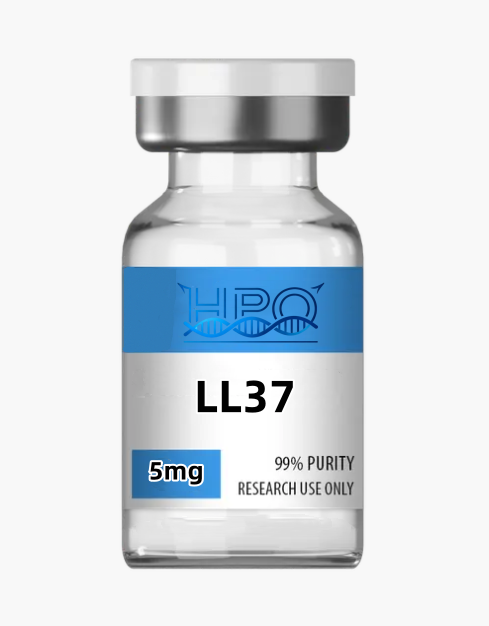
LL37
$70.00
LL-37 peptide is a synthetic 37-residue human cathelicidin research material for antimicrobial, biofilm, innate-immunity, membrane, and wound-model studies. 5mg × 10 vials; laboratory research use only and not for human or animal administration.
DISCLAIMER:
LL37 Peptide: Human Cathelicidin Research Guide
LL-37 peptide is the 37-amino-acid C-terminal antimicrobial region released from human cathelicidin antimicrobial peptide (CAMP), also called hCAP18. It is a cationic, amphipathic host-defense peptide studied in innate-immunity, microbial-membrane, biofilm, inflammatory-signaling, epithelial, and wound-model research. LL-37 is not simply an antibiotic substitute: its observed activity depends strongly on the microorganism, membrane composition, salt, serum, pH, peptide concentration, and host-cell context.
Hanpro Peptides supplies synthetic LL37 peptide as a lyophilized research material. The current catalog specification is 5mg × 10 vials. This quantity describes packaging only and is not an experimental or clinical dose. The material is intended strictly for laboratory, analytical, in-vitro, and appropriately authorized preclinical research. It is not a medicine, cosmetic ingredient, dietary supplement, or veterinary product and must not be administered to humans or animals.
LL-37 identity and molecular characteristics
| Research name | LL-37 peptide |
|---|---|
| Related names | LL37, antibacterial peptide LL-37, human cathelicidin peptide |
| Biological precursor | Human CAMP/hCAP18 pre-proprotein |
| Length | 37 amino-acid residues |
| Sequence | LLGDFFRKSKEKIGKEFKRIVQRIKDFLRNLVPRTES |
| Molecular formula | C205H340N60O53 for the unmodified free peptide |
| Approximate molecular mass | 4,493 g/mol |
| Structural class | Cationic, amphipathic host-defense peptide; adopts substantial alpha-helical character in membrane-like environments |
| Catalog specification | 5mg × 10 vials |
| Intended use | Laboratory research and analytical use only |
The name LL-37 reflects the peptide’s two N-terminal leucines and its 37-residue length. The reviewed UniProt entry P49913 identifies LL-37 as a processed chain at the C-terminus of the 170-residue human CAMP precursor. A primary study showed that extracellular proteinase 3 can cleave hCAP18 after neutrophil exocytosis to generate LL-37. Therefore, experiments using the mature synthetic peptide should not be described as experiments using the complete hCAP18 precursor.
The listed molecular mass is a reference value for the unmodified peptide. Actual gravimetric calculations can be affected by counterions, water, peptide content, and the supplied form. Researchers should use the lot label and certificate of analysis for identity and concentration calculations rather than assume that gross vial mass equals net peptide content.
Why researchers study LL37 peptide
1. Microbial membrane interaction
LL-37 can associate with anionic microbial surfaces and, under suitable experimental conditions, disrupt membrane organization and permeability. The peptide’s amphipathic arrangement allows hydrophobic residues to interact with lipid regions while charged residues remain compatible with an aqueous interface. However, the mechanism is not universal across organisms or assay matrices. Lipid composition, ionic strength, inoculum density, growth phase, and extracellular polymers can substantially change the observed response.
Researchers commonly examine Gram-positive and Gram-negative bacteria, fungi, model lipid vesicles, or supported bilayers. Useful readouts include broth microdilution, time-kill curves, membrane-potential dyes, permeability probes, leakage assays, electron microscopy, and lipid-binding measurements. Orthogonal methods are valuable because an optical viability assay alone cannot distinguish membrane disruption from aggregation, dye interference, or metabolic suppression.
2. Biofilm formation and established biofilms
LL37 peptide is also studied in biofilm models. A primary Pseudomonas aeruginosa study reported inhibition of biofilm formation at concentrations below the planktonic minimum inhibitory concentration, with changes in attachment, twitching motility, and quorum-sensing-associated gene expression. Other studies have tested LL-37 against Staphylococcus aureus and mixed microbial systems. These results are assay- and species-specific; they should not be generalized into a claim that LL-37 eradicates all biofilms.
A strong design separates at least three questions: prevention of initial attachment, inhibition of biofilm maturation, and disruption or killing within an established biofilm. Crystal-violet biomass, viable colony counts, metabolic assays, confocal imaging, and extracellular-matrix measurements answer different questions. Include planktonic controls and report whether the endpoint represents biomass, viability, architecture, or gene expression.
3. Lipopolysaccharide interaction
LL-37 binds bacterial lipopolysaccharide (LPS) in biochemical and cellular systems. Researchers use this property to investigate peptide–endotoxin complexes, membrane recognition, endocytosis, and changes in Toll-like receptor-associated readouts. For example, a human liver sinusoidal endothelial-cell study reported enhanced uptake and lysosomal trafficking of LL-37–LPS complexes without the tested TLR4 activation pattern. This is a mechanistic observation in a defined model, not proof of a clinical anti-inflammatory effect.
When testing LPS-related hypotheses, control the LPS chemotype, aggregation state, peptide:LPS ratio, serum, incubation order, endotoxin contamination, and assay timing. Polymyxin B or a validated LPS-binding comparator may help, but it does not reproduce every property of LL-37. Endotoxin-free consumables and independent endotoxin measurements are important because trace contamination can dominate immune-cell results.
4. Immune-cell signaling and chemotaxis
In addition to direct membrane activity, LL-37 can modify host-cell signaling. A foundational study found chemotaxis and calcium mobilization in human monocytes and FPRL1-expressing cells; the receptor is now generally called formyl peptide receptor 2 (FPR2). Other models implicate additional receptors or membrane-dependent mechanisms. Mast-cell experiments, for instance, have reported degranulation and mediator release involving MRGPRX2.
Consequently, researchers should avoid treating LL-37 as a single-receptor ligand. Receptor expression, cell type, differentiation state, peptide aggregation, and serum can change the response. Appropriate controls may include receptor antagonists, genetic knockdown or knockout, receptor-null cells, calcium-flux controls, viability testing, and measurements of peptide adsorption or degradation.
5. Epithelial migration and wound models
LL-37 is frequently investigated in epithelial and wound-repair models. In cultured keratinocytes, a primary study linked LL-37-induced migration to heparin-binding EGF-mediated transactivation of EGFR and downstream STAT3 signaling. Researchers may therefore examine scratch closure, transwell migration, proliferation, differentiation, barrier markers, extracellular-matrix remodeling, or signaling phosphorylation.
Scratch assays require careful interpretation because reduced wound area can reflect migration, proliferation, cell spreading, or imaging bias. Pair live imaging with proliferation and viability measurements, define the scratch geometry, and report serum conditions. An in-vitro keratinocyte response does not establish wound-healing efficacy or safety in humans.
Context-dependent and potentially opposing effects
LL-37 is multifunctional rather than uniformly anti-inflammatory. Depending on the model and concentration, it can neutralize microbial components, recruit immune cells, stimulate mast-cell degranulation, alter cytokine production, or damage host-cell membranes. Published work also shows that serum and salts can reduce antimicrobial activity. Proteases may cleave LL-37, while lipid or protein binding can change the freely available concentration.
Therefore, every experiment should include a concentration-response series and a time course rather than rely on a single condition. Pair functional readouts with cytotoxicity, membrane integrity, apoptosis, or cell-count measurements. Report both nominal and, where feasible, recovered concentration. A change in cytokine output should not automatically be labeled beneficial or harmful without a defined comparator and mechanistic context.
Experimental design checklist
- Define the question: distinguish microbial killing, biofilm modulation, membrane permeabilization, LPS interaction, chemotaxis, receptor signaling, epithelial migration, and peptide stability.
- Use matched controls: include untreated, vehicle, positive, scrambled-sequence or inactive-peptide controls when scientifically appropriate.
- Document the matrix: report buffer, pH, salt, serum or albumin, plastic type, microbial inoculum, cell density, and incubation time.
- Verify identity and recovery: use lot documentation and fit-for-purpose LC-MS or chromatographic analysis where peptide identity or stability is critical.
- Separate activity from toxicity: pair antimicrobial or signaling endpoints with host-cell viability, membrane-damage, and assay-interference controls.
- Use orthogonal endpoints: combine biomass, viable counts, imaging, signaling, or biochemical measurements rather than rely on one colorimetric assay.
- Plan reproducibility: predefine replicates, randomization, exclusion criteria, normalization, statistical analysis, and complete reporting of peptide form and lot.
Handling and analytical considerations
Review the current label, safety information, and lot-specific certificate before opening the vial. Establish and document a laboratory procedure for solvent selection, pH, mixing, container type, target concentration, storage interval, and freeze-thaw limits. Do not copy preparation instructions from a clinical product or another supplier, because peptide form, concentration, excipients, and analytical purpose may differ.
LL-37 can interact with surfaces, proteins, lipids, and polyanions. Low-binding consumables and matrix-recovery controls may help when working at low concentrations, but laboratories should validate them in their own system. Avoid vigorous handling unless it has been shown not to alter aggregation or recovery. Where solution stability matters, assess it under the actual buffer, temperature, concentration, light, and container conditions used in the study.
Reversed-phase HPLC or UPLC can support purity and degradation profiling, while LC-MS or high-resolution MS can confirm molecular identity. Circular dichroism, NMR, fluorescence leakage, or microscopy may be useful for secondary-structure and membrane studies. Chemical purity alone does not establish biological potency, so a relevant functional assay is needed when activity is an experimental requirement.
Frequently asked questions
Is LL-37 the same as hCAP18?
No. hCAP18 is the full human cathelicidin precursor protein. LL-37 is the 37-residue mature C-terminal peptide released from that precursor by proteolytic processing. Researchers should identify which molecular form their assay uses.
Is LL37 peptide only an antimicrobial reagent?
No. It is studied in microbial-membrane and biofilm systems, but also in LPS binding, chemotaxis, immune-cell signaling, epithelial migration, receptor biology, and peptide-structure research. Its effects are context dependent and can include pro-inflammatory or cytotoxic responses.
What LL-37 concentration should a laboratory use?
There is no universal concentration. Choose a starting range from peer-reviewed work using a closely matched organism, cell type, matrix, endpoint, and peptide form, then validate it with concentration-response, time-course, recovery, and toxicity controls. The 5mg vial size is not a dose recommendation.
Can this LL-37 product be used to treat an infection or wound?
No. This catalog item is a laboratory research material, not an approved antimicrobial, wound-care product, medicine, or cosmetic. It must not be used for human or animal administration, treatment, diagnosis, or disease prevention.
Why might two laboratories obtain different antimicrobial results?
Salt, serum, pH, inoculum, growth phase, microbial strain, plate material, peptide adsorption, aggregation, degradation, and endpoint selection can all change apparent activity. Full method reporting and matrix-matched controls are essential for comparison.
How should LL-37 be stored after preparation?
Follow the current label and lot-specific documentation. Solution stability depends on buffer, pH, concentration, container, temperature, protein content, and freeze-thaw history. Establish acceptable conditions with a stability-indicating analytical method rather than assume a universal rule.
Does chromatographic purity establish LL-37 biological activity?
No. Chromatographic purity and molecular identity answer different questions from functional activity. Use fit-for-purpose identity, recovery, stability and biological controls for the chosen experiment; do not treat a purity percentage as proof of potency or clinical suitability.
Related research materials
- KPV – tripeptide used in controlled inflammatory-signaling and epithelial research.
- GHK-Cu – copper-binding tripeptide for extracellular-matrix and cell-response studies.
- VIP – neuropeptide for receptor, barrier, and immunoregulatory pathway research.
Other catalog entries include ARA-290, Thymosin Alpha-1, BPC-157, TB500, and reduced glutathione. These links identify separate research materials, not interchangeable reagents or recommendations for administration or combinations. Review each material’s identity, evidence and documentation independently.
Selected scientific references
- UniProt P49913: reviewed human CAMP precursor and processed LL-37 chain.
- PubChem: human cathelicidin LL-37 sequence and molecular properties.
- Proteinase 3 processing of hCAP18 to LL-37.
- LL-37 expression and antimicrobial activity at the human airway surface.
- LL-37 chemotaxis and FPRL1/FPR2-associated signaling.
- LL-37 modulation of Pseudomonas aeruginosa biofilm formation.
- LL-37-induced keratinocyte migration and EGFR transactivation.
- Cellular uptake of LL-37–LPS complexes in a defined endothelial model.
- MRGPRX2-associated human mast-cell activation by LL-37.
Research-use disclaimer
LL37 peptide from Hanpro Peptides is supplied strictly for laboratory research and analytical use. It is not a medicine, cosmetic, dietary supplement, or veterinary product. It must not be used for human or animal consumption, administration, diagnosis, treatment, or prevention of disease. Purchasers are responsible for lawful procurement, institutional approval, risk assessment, safe handling, storage, experimental suitability, and disposal.
| Specification | 5mg*10vials |
|---|
Only logged in customers who have purchased this product may leave a review.
Related products
Reviews
There are no reviews yet.