
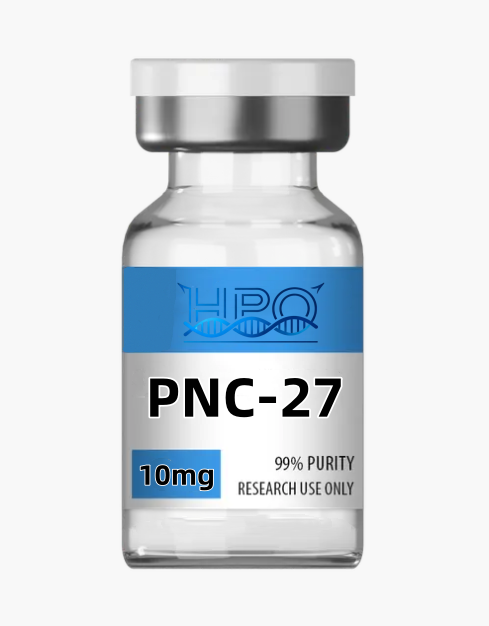
PNC-27
$130.00
PNC-27 is a 32-residue p53–penetratin chimeric peptide for controlled laboratory studies of membrane-associated HDM2 and pore-formation mechanisms. Research use only; not for human or animal consumption.
DISCLAIMER:
PNC-27 Peptide: p53–HDM2 Research Guide
PNC-27 peptide is a synthetic 32-amino-acid chimeric research peptide composed of the HDM2-binding region of human p53 residues 12–26 joined to a 17-residue penetratin-derived membrane-residency sequence. It has been investigated in cell-culture, imaging, structural, and animal models focused on membrane-associated HDM2, peptide-induced pore formation, and tumor-cell necrosis. Hanpro Peptides supplies PNC-27 as a lyophilized reagent for laboratory research and analytical development only. It is not an approved drug and is not intended for human or animal consumption.
Published findings are experimental and model dependent. Several studies reported preferential activity in selected transformed cell lines or AML models relative to the normal-cell controls used in those experiments. That does not justify a universal statement that every cancer cell is susceptible or that all normal cells are unaffected. Membrane HDM2 abundance, cell type, peptide concentration, exposure time, assay format, and reagent quality can materially affect the outcome.
Identity and sequence
| Name | PNC-27 |
|---|---|
| Length | 32 amino acids |
| Sequence | PPLSQETFSDLWKLLKKWKMRRNQFWVKVQRG |
| Domain 1 | p53 residues 12–26: PPLSQETFSDLWKLL |
| Domain 2 | Penetratin/MRP sequence: KKWKMRRNQFWVKVQRG |
| Approximate free-peptide mass | 4031.7 Da; verify the exact salt and counterion form on the lot COA |
| Form | Lyophilized research material |
| Intended use | In-vitro, analytical, and institutionally approved preclinical research only |
The N-terminal p53-derived segment contains residues associated with binding to the N-terminal pocket of HDM2. The C-terminal penetratin sequence is highly basic and amphipathic, properties relevant to membrane interaction. NMR work reported environment-dependent helical organization, while later imaging studies examined intact peptide localization and pore-like structures. Researchers should distinguish direct observations from mechanistic interpretation and reproduce key endpoints with appropriate controls.
Research mechanism under investigation
Membrane-associated HDM2 binding
HDM2, also called MDM2, is best known as a regulator of p53. PNC-27 research has examined a different context: HDM2 detected at the plasma membrane of selected transformed cells. Colocalization and transfection experiments reported that PNC-27 associates with membrane-localized HDM2 and that introducing membrane-targeted HDM2 into a previously less-susceptible untransformed line increased susceptibility in that model.
Transmembrane pore formation
Electron-microscopy and fluorescence studies have described pore-like membrane structures containing PNC-27 and HDM2, followed by loss of membrane integrity and release of intracellular contents. This pattern is commonly characterized as membranolytic necrosis rather than classical caspase-dependent apoptosis. A laboratory should measure membrane permeability, LDH release, morphology, and viability with orthogonal assays rather than relying on one colorimetric endpoint.
p53-independent experimental activity
Because the proposed interaction occurs at membrane-associated HDM2, reported activity has been observed in p53-deficient models, including K562 leukemia cells. This is an experimental mechanistic observation, not evidence that p53 status alone predicts response. Direct measurement of membrane HDM2 and comparison with cytosolic or nuclear pools are essential.
Acute myeloid leukemia models
A 2019 study examined membrane HDM2 in human and murine AML blasts, leukemia-stem-cell-enriched populations, and normal hematopoietic stem-cell controls. PNC-27 was evaluated in cell and transplant models, with reported effects on AML populations and limited effects on the normal hematopoietic controls used. These results remain preclinical and do not establish clinical safety, efficacy, dosing, or regulatory approval.
Recommended experimental design
- Vehicle and untreated controls: identify effects of solvent and handling.
- Negative peptide control: PNC-29 or another justified sequence control can help test sequence specificity.
- Membrane-HDM2 characterization: use validated surface staining, fractionation, or imaging before interpreting susceptibility.
- Normal-cell comparator: select a biologically relevant untransformed control instead of generalizing from one line.
- Concentration and time course: establish response curves and distinguish rapid membrane effects from later secondary changes.
- Orthogonal viability assays: combine LDH release, membrane-impermeant dyes, microscopy, and metabolic or clonogenic measurements.
- Apoptosis/necrosis discrimination: include caspase, Annexin V, and morphology endpoints where appropriate.
- Cell-free interference wells: test whether the peptide alters optical or fluorescent assay chemistry.
Analytical quality considerations
PNC-27 is a long, highly basic peptide with multiple lysine and arginine residues. Identity may be supported by LC-MS or MALDI-MS, while reversed-phase HPLC or UPLC can assess peptide-related impurities. Chromatographic area purity is not the same as peptide content, sterility, endotoxin status, water content, or counterion composition. Review the lot-specific COA and independently confirm attributes that are critical to the planned assay.
The exact molecular mass depends on the reported form, terminal groups, counterions, and hydration. Use the sequence and the applicable COA rather than copying a generic molecular formula into quantitative work. For highly sensitive cell studies, investigate endotoxin and bioburden as potential confounders. Aggregation, adsorption to plastic, proteolysis, and freeze-thaw history can also change the effective concentration.
Handling and stability
Store unopened lyophilized material according to the label and lot documentation, protected from moisture and unnecessary light exposure. Before opening a cold vial, allow it to equilibrate while sealed if condensation is a concern. Determine solvent, pH, container, and concentration compatibility in a small analytical pilot.
For prepared research solutions, use documented low-binding materials where justified, mix gently, prepare aliquots, and minimize repeated freeze-thaw cycles. Establish stability under the actual matrix and temperature used in the experiment. A generic storage interval cannot replace a stability-indicating method. This page intentionally provides no route of administration or human/animal dose.
Reproducibility, sample tracking and result interpretation
Build a sample record before beginning the experiment. Record the supplier item, lot identifier, sequence, terminal chemistry, counterion information, nominal fill, preparation date and the analytical evidence available for that lot. Assign separate identifiers to the dry material, stock solution, working dilutions and retained samples. This makes it possible to distinguish a biological difference from a preparation, storage or labeling error when results are reviewed later.
For quantitative comparisons, define the calculation basis explicitly. A concentration calculated from total vial mass may differ from one calculated from measured peptide content. Record the balance, pipette, solvent volume, dilution factors and applicable molecular-mass basis. When content or recovery is uncertain, report that uncertainty rather than present an unsupported exact concentration. Keep the same preparation basis across comparator arms and document any deviation from the planned method.
Prespecify the principal endpoint and the criteria for a usable assay run. Include instrument blanks, vehicle wells and appropriate positive and negative controls. Define how background subtraction, normalization and outlier handling will be performed before seeing the final response pattern. Technical replicate wells measure repeatability within a run; independent biological experiments are needed to assess reproducibility across preparations, culture days or cell batches. Report both rather than combining them into a single unexplained sample count.
For imaging experiments, document acquisition settings, exposure, segmentation rules and the number of fields analyzed. Use comparable settings across groups and retain the original images. Where feasible, blind the image analysis to treatment identity. A visually striking field should not replace a systematically collected dataset, and the selected images should illustrate the quantified result rather than determine it.
Interpret discordant endpoints as information requiring investigation, not as a reason to discard an inconvenient measurement. An optical signal, membrane-integrity readout and longer-term recovery measurement may answer different questions. Check matrix interference, sample recovery, cell number and timing before assigning a mechanistic explanation. Report negative or inconclusive results alongside positive findings and restrict conclusions to the preparation, model and endpoints actually tested.
Finally, maintain a clear boundary between an experimental observation and clinical suitability. Cell-based activity does not establish patient benefit, acceptable toxicity, an administration route or a treatment regimen. Catalog links identify separate research materials and should not be interpreted as recommendations for combination experiments, self-administration or clinical use. Qualified investigators must establish their own lawful, institutionally reviewed research procedures.
Frequently asked questions
What is PNC-27?
PNC-27 is a 32-residue chimeric peptide combining the p53 12–26 HDM2-binding sequence with a penetratin-derived membrane-residency sequence.
What is the correct PNC-27 sequence?
The published one-letter sequence is PPLSQETFSDLWKLLKKWKMRRNQFWVKVQRG. Researchers should verify terminal chemistry, counterion form, and lot identity on the COA.
Does PNC-27 cure cancer?
No clinical claim is supported. Published work consists mainly of cell, structural, imaging, and preclinical animal studies. These findings do not establish safety or efficacy in patients.
Is PNC-27 activity dependent on p53?
Reported membrane-lysis activity has occurred in p53-deficient models and is proposed to involve membrane-associated HDM2. However, p53 status alone should not be used as a response predictor.
Does PNC-27 affect only cancer cells?
Several studies reported preferential effects in tested transformed cells compared with selected untransformed controls. That is not proof of absolute selectivity across all tissues or experimental conditions.
How should PNC-27 be quantified?
Use a fit-for-purpose method such as HPLC/UPLC with mass-spectrometric identity confirmation. Quantitative work should account for peptide content, counterions, water, adsorption, and degradation.
Can PNC-27 be administered to people or animals?
No. This product is for laboratory research only and is not intended for human or animal consumption, self-administration, diagnosis, or treatment.
Related research products
- GHK-Cu + KPV Blend – a copper-peptide formulation for comparative research.
- AHK-Cu – an Ala-His-Lys copper tripeptide research material.
- BPC-157 – a distinct preclinical research peptide.
- TB500 – a thymosin-beta-4-related material.
- LL-37 – a human cathelicidin-derived research peptide.
- Humanin – a mitochondrial-derived peptide research material.
- Vilon – a Lys-Glu dipeptide research material.
- Cartalax – an Ala-Glu-Asp tripeptide research material.
Selected references
- Rosal R, et al. NMR solution structure of a peptide from the mdm-2 binding domain of p53. Biochemistry. 2004. PMID: 14967026.
- Sarafraz-Yazdi E, et al. PNC-27 adopts an HDM-2-binding conformation and kills cancer cells by binding to HDM-2 in their membranes. PNAS. 2010. PubMed PMID: 20080680.
- Sookraj KA, et al. PNC-27 induces tumor cell lysis as the intact peptide. Cancer Chemother Pharmacol. 2010. PMID: 20182728.
- Qin L, et al. Targeting cell membrane HDM2: A novel therapeutic approach for acute myeloid leukemia. Leukemia. 2019. PMID: 31337857.
- Krzesaj P, et al. Anti-Cancer Peptide PNC-27 Kills Cancer Cells by Unique Interactions with Plasma Membrane-Bound HDM-2. Ann Clin Lab Sci. 2024. PMID: 38802154.
Research-use disclaimer
PNC-27 is supplied exclusively for lawful laboratory research and analytical purposes. It is not approved to diagnose, treat, cure, or prevent disease and is not intended for human or animal consumption. Qualified investigators are responsible for institutional review, biosafety, appropriate controls, lawful use, and disposal.
| Specification | 10mg*10vials |
|---|
Only logged in customers who have purchased this product may leave a review.
Related products
Reviews
There are no reviews yet.