

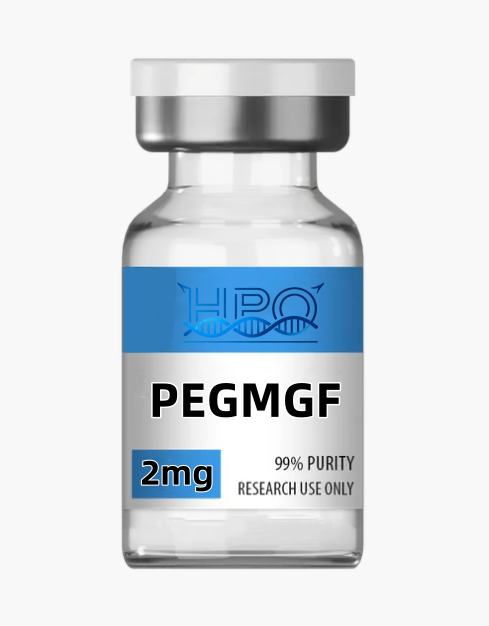
Peg mgf
$100.00
PEG-MGF is a PEGylated synthetic research peptide related to IGF-1Ec E-domain studies, supplied for controlled identity, stability, signaling, and analytical work. Not for human or animal consumption.
DISCLAIMER:
PEG-MGF Research Peptide: IGF-1Ec E-Domain and PEGylation Guide
PEG-MGF is a PEGylated synthetic research peptide associated with the mechano growth factor (MGF) E-domain literature. It is intended for controlled laboratory investigation of peptide identity, PEG conjugation, stability, analytical behavior, and cell-signaling hypotheses. It is not a medicine, supplement, or performance-enhancing product.
Identity Matters: PEG-MGF Is Not the Same as Mature IGF-1
The term “MGF” is commonly linked to human IGF-1Ec, an alternatively spliced IGF-1 transcript with a distinctive E-domain sequence. Several related materials may appear in the literature: the full IGF-1Ec precursor, mature IGF-1, an isolated synthetic MGF E-peptide, and a PEGylated version of an E-peptide. These are not interchangeable. PEG attachment can change size, heterogeneity, solubility, assay recovery, and biological behavior.
For this reason, researchers should confirm the exact peptide sequence, PEG size, attachment site, conjugation ratio, average mass distribution, counterion, fill amount, and purity method from the lot-specific certificate of analysis (COA). A generic product name alone does not establish molecular identity.
Research Profile
| Common name | PEG-MGF |
|---|---|
| Related terminology | PEGylated MGF E-peptide; pegylated mechano growth factor |
| Research class | PEG-conjugated synthetic peptide |
| Biological context | IGF-1 alternative-splicing and E-domain research |
| Sequence and PEG specification | Lot-specific; verify in the COA and identity documents |
| Format | Lyophilized research material; confirm the selected variant and lot fill |
| Intended use | Laboratory research only |
Scientific Context
Early cell-culture work reported that an IGF-1Ec E-domain peptide produced responses that differed from mature IGF-1 in myoblast models. Later studies investigated synthetic 24-amino-acid C-terminal E-peptides in human muscle progenitor cells and other cell systems. These findings are model-dependent and do not establish a clinical effect, consumer benefit, or validated mechanism for a particular commercial PEG-MGF preparation.
Published experiments also disagree on whether observed E-peptide responses require IGF-1 receptor signaling. That variability makes receptor controls, matched peptide comparators, and orthogonal readouts especially important. Results obtained with an unmodified E-peptide should not be transferred automatically to a PEGylated analog.
What PEGylation Changes
PEGylation adds polyethylene glycol to a peptide. Depending on PEG molecular weight, linkage chemistry, attachment site, and conjugation distribution, it may alter proteolytic stability, hydrodynamic size, adsorption, chromatographic retention, mass-spectrometric response, and apparent potency. “PEG-MGF” therefore does not have one universal half-life or activity profile.
Study reports should document the conjugate used and separate conclusions about chemical stability from conclusions about biological activity. Nominal vial content is not a substitute for measuring the concentration actually delivered to an assay.
Recommended Experimental Controls
- Vehicle-only and untreated controls.
- A sequence-matched, non-PEGylated MGF E-peptide comparator.
- A PEG-only or chemistry-matched control when technically possible.
- Mature IGF-1 as a distinct pathway comparator, not as an identity substitute.
- Concentration-response and time-course designs with predefined endpoints.
- IGF1R inhibition or genetic perturbation where receptor dependence is being tested.
- Viability, cytotoxicity, and assay-interference controls.
- Independent replication and at least one orthogonal readout.
Analytical Verification
PEG conjugates can produce broad or multi-peak profiles, so a single purity percentage is rarely sufficient to characterize the material. A fit-for-purpose verification plan may include reversed-phase HPLC or UPLC, size-exclusion chromatography, intact-mass analysis, peptide mapping where appropriate, water-content assessment, and aggregate or particulate checks. MALDI or ESI spectra should be interpreted with the expected PEG mass distribution in mind.
For cell-based work, researchers may also need documented endotoxin limits, sterility or bioburden controls, and recovery studies in the selected matrix. The analytical method, wavelength or detector, integration approach, reference standard, and acceptance criteria should be recorded.
Handling and Study Preparation
- Follow the lot-specific COA and handling documentation.
- Use low-binding vessels when adsorption loss is plausible.
- Record solvent, buffer composition, pH, concentration, and preparation time.
- Prepare aliquots suitable for the study and minimize repeated freeze-thaw cycles.
- Confirm stability in the actual assay matrix rather than assuming stability from the PEG label.
- Protect samples from conditions known to affect the documented linkage or peptide sequence.
Evidence Boundaries
Most MGF E-peptide evidence comes from biochemical, cell-culture, or animal models. A synthetic isolated E-peptide does not reproduce every feature of the endogenous IGF-1Ec precursor, and a PEGylated analog introduces additional structural variables. Product evaluation should therefore focus on traceable identity, transparent analytical data, appropriate controls, and conclusions limited to the tested model.
Frequently Asked Questions
Is PEG-MGF the same as IGF-1?
No. The name refers to a PEGylated synthetic material related to MGF E-domain research. Mature IGF-1, full IGF-1Ec, an isolated E-peptide, and a PEG conjugate are distinct research entities.
Does PEGylation guarantee a specific half-life?
No. Stability and persistence depend on PEG size, linkage, attachment site, formulation, matrix, temperature, and assay conditions. These properties must be measured for the actual lot and protocol.
Can the listed amount confirm peptide concentration?
No. A nominal fill amount should be checked against the lot documentation and, when concentration accuracy is critical, verified with an appropriate quantitative method.
What documentation should accompany the material?
At minimum, researchers should look for lot identification, sequence or identity information, PEG specification, analytical method, purity or composition data, and handling guidance. Additional endotoxin or microbiological documentation may be required by the experimental system.
Selected Research References
- Yang SY, Goldspink G. Different roles of the IGF-I Ec peptide (MGF) and mature IGF-I in myoblast proliferation and differentiation. FEBS Letters. 2002;522:156-160. PMID: 12095637.
- Kandalla PK, Goldspink G, Butler-Browne G, Mouly V. Mechano Growth Factor E peptide, derived from an isoform of IGF-1, activates human muscle progenitor cells and induces an increase in their fusion potential at different ages. Mechanisms of Ageing and Development. 2011;132:154-162. PMID: 21354439.
- Cui H, Yi Q, Feng J, Yang L, Tang L. Mechano growth factor E peptide regulates migration and differentiation of bone marrow mesenchymal stem cells. Journal of Molecular Endocrinology. 2014;52:111-120. PMID: 24323763.
Research use only. Not for human or animal consumption, diagnosis, treatment, or performance enhancement. Researchers are responsible for institutional approvals, applicable regulations, risk assessment, and safe laboratory practice.
Related Research Guides
Expand your peptide research knowledge with our comprehensive guides:
- Peptides for Anti-Aging: Complete Research Guide 2026
- Peptides for Cognitive Enhancement: Nootropic Research Guide 2026
- Peptides for Metabolic Health: Weight Loss Research Guide 2026
- Peptides for Athletic Performance: Muscle Growth Research Guide 2026
- Peptides for Skin Health: Dermatological Research Guide 2026
- Peptides for Sleep Optimization: Circadian Rhythm Research Guide 2026
Related Peptide Research Guides
- Peptides for Bone Health and Mineral Metabolism: Complete Research Guide 2026
- Peptides for Emotional Health and Stress Management: Complete Research Guide 2026
- Peptides for Exercise Recovery and Muscle Repair: Complete Research Guide 2026
- Peptides for Cognitive Enhancement and Neuroprotection: Complete Research Guide 2026
- Peptides for Metabolic Health and Insulin Sensitivity: Complete Research Guide 2026
- Peptides for Skin Health and Anti-Aging: Complete Research Guide 2026
- Peptides for Sleep Optimization and Circadian Rhythm: Complete Research Guide 2026
- Peptides for Sexual Health and Fertility: Complete Research Guide 2026
| Specification | 2mg*10vials |
|---|
Only logged in customers who have purchased this product may leave a review.
Related products
Reviews
There are no reviews yet.