
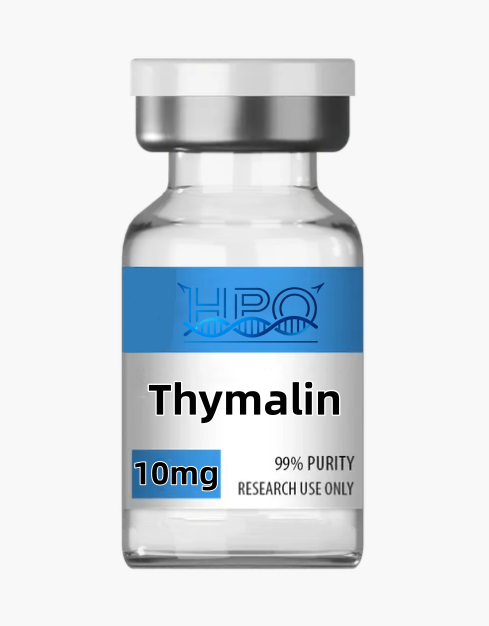
Thymalin
$50.00
Thymalin is a research peptide preparation for controlled composition, identity, stability, and assay studies. Verify lot-specific documentation; for laboratory research use only.
DISCLAIMER:
Thymalin Research Peptide Preparation: Identity and Analysis Guide
Thymalin research peptide material is best understood as a thymus-derived peptide preparation rather than a single, sequence-defined peptide. Published literature describes Thymalin as a natural peptide preparation obtained from calf thymus, while later analytical work identified several low-molecular-weight components within thymus-derived fractions. This distinction matters: researchers should not assume that Thymalin has one molecular formula, one molecular weight, or the same composition as thymosin alpha-1, thymosin beta-4, thymopentin, or the synthetic Glu-Trp dipeptide.
For reproducible laboratory work, the lot-specific Certificate of Analysis (COA), preparation method, peptide profile, and test results should take priority over generalized descriptions. This page provides a research-oriented framework for identity assessment, analytical comparison, handling, and experimental controls. It does not make therapeutic or clinical claims.
What Is Thymalin?
In the scientific literature, Thymalin is described as a peptide preparation originating from thymic tissue. A PubMed-indexed review reports that natural thymic peptides were isolated from calf thymus by mild acid extraction and that the dipeptide Glu-Trp was subsequently isolated from Thymalin by reversed-phase HPLC. More recent analytical discussion describes a pool of several tryptophan-containing dipeptides in a low-molecular-weight fraction of the preparation. These findings support treating Thymalin as a compositionally complex preparation, not as a pure single peptide.
Researchers comparing sources should document whether a product is tissue-derived, fractionated, reconstructed, or represented as a synthetic blend. Those categories are not automatically interchangeable. The declared manufacturing route, acceptance criteria, and analytical fingerprint should be recorded for every lot.
Thymalin Versus Other Thymic Peptides
- Thymalin: a peptide preparation or mixture described in the literature as originating from thymic tissue.
- Thymosin alpha-1: a defined 28-amino-acid peptide with a distinct sequence and analytical identity.
- Thymosin beta-4: a separate, sequence-defined peptide and not a synonym for Thymalin.
- Thymopentin: a defined five-residue peptide derived from a region of thymopoietin.
- Thymogen (Glu-Trp): a synthetic dipeptide associated with research on low-molecular-weight thymic fractions.
Substituting one material for another can change assay interpretation. Product naming alone is insufficient evidence of equivalent composition or activity.
Recommended Identity and Quality Checks
A fit-for-purpose characterization plan for a Thymalin research peptide preparation may include:
- Documentation review: confirm lot number, manufacturing route, test date, storage statement, and acceptance criteria on the COA.
- Chromatographic fingerprinting: use RP-HPLC or UHPLC to compare peak patterns, retention-time windows, and relative peak areas across lots.
- Mass-spectrometric profiling: use LC-MS or LC-MS/MS to examine detectable peptide ions and, where possible, support component assignment.
- Total peptide or protein measurement: select a validated assay appropriate to the expected composition and matrix; different colorimetric methods may not be directly comparable.
- Water and residual-solvent testing: evaluate when these variables can affect mass balance, reconstitution, or stability.
- Bioburden or endotoxin testing: include only when relevant to the planned assay, with method suitability and interference controls.
A single “purity” percentage may not adequately describe a mixture. The method, detector, integration rules, and reference standard should accompany any reported value.
Experimental Design and Controls
Because composition can vary between preparations and lots, study design should separate material-specific effects from vehicle, handling, or assay artifacts. Useful controls include:
- vehicle-only and untreated controls;
- a concentration series selected from preliminary range-finding work;
- a comparator peptide only when its identity and rationale are clearly defined;
- technical replicates and independent biological replicates;
- matched handling time and freeze-thaw history;
- an orthogonal readout to confirm the primary assay result;
- lot-to-lot bridging samples when a study spans more than one batch.
For cell-based research, assess matrix compatibility, sterility requirements, cytotoxicity, and potential assay interference before interpreting pathway or phenotype changes. Historical animal or clinical reports should not be treated as proof that a specific commercial research lot has the same composition or performance.
Reconstitution and Handling for Research
Use the lot-specific product documentation as the primary handling instruction. Before opening, allow a sealed vial to equilibrate under controlled conditions to reduce condensation risk. Choose a solvent compatible with both the material and the downstream method, and record solvent composition, pH, concentration, mixing procedure, and time to analysis.
Prepare small working aliquots when repeated sampling is expected. Avoid unnecessary freeze-thaw cycles and prolonged exposure to heat, moisture, or strong light. Do not assume a universal solution-storage period: stability depends on composition, concentration, buffer, container, temperature, and analytical endpoint. Establish stability with a time-course study when quantitative comparability matters.
Batch Comparability Strategy
- Archive the COA and a retained sample from each lot.
- Run new and reference lots in the same chromatographic sequence.
- Compare overall fingerprints rather than relying on one selected peak.
- Review mass spectra for new, missing, or shifted component signals.
- Use the same validated functional assay and predefined acceptance window.
- Document deviations before pooling results across lots.
This approach is especially important for complex peptide preparations because nominal fill amount alone does not establish compositional equivalence.
Frequently Asked Questions
Is Thymalin a single peptide?
No. Published descriptions characterize it as a natural thymic peptide preparation containing multiple low-molecular-weight components. A product-specific COA should clarify how the supplied material is defined.
Does Thymalin have one molecular weight or sequence?
A mixture does not have one definitive peptide sequence or molecular weight. Component-level assignments require suitable separation and mass-spectrometric evidence.
Can Thymalin and thymosin alpha-1 be used interchangeably?
No. Thymosin alpha-1 is a defined peptide, whereas Thymalin is described as a preparation. Any comparison should be designed explicitly and interpreted according to the verified identity of each material.
What should be compared between lots?
Compare documentation, chromatographic fingerprints, mass-spectral profiles, relevant impurity or contamination tests, and a fit-for-purpose functional readout. Predefine acceptance criteria before testing the replacement lot.
Selected Research References
- Morozov and Khavinson: natural and synthetic thymic peptides — describes Thymalin as a natural thymic peptide preparation and reports isolation of Glu-Trp by reversed-phase HPLC.
- Review of thymus-derived short peptide research — discusses multiple tryptophan-containing dipeptides identified in a low-molecular-weight Thymalin fraction.
Research Use Only
For laboratory research use only. Not for human or veterinary use, food, cosmetic use, clinical diagnosis, or self-administration. Researchers are responsible for confirming identity, suitability, storage, and applicable institutional requirements before use.
| Specification | 10mg*10vials |
|---|
Only logged in customers who have purchased this product may leave a review.
Related products
Reviews
There are no reviews yet.